The car arrives in three weeks and somebody has told you that you need a panel upgrade. Maybe you do. Plenty of people are told they do and then find out they never did.
The honest answer depends on numbers specific to your house, and there is a real calculation behind it rather than a rule of thumb. Here is how that calculation works, so you can tell a real answer from a guess.
First, what kind of charging do you actually need
There are two options at a house, and the difference matters before anything else does.
Level 1 is an ordinary household outlet. No installation, no electrician, nothing to decide. It adds a few miles of range per hour, which over a night is enough for a lot of commutes and not enough for most other things.
Level 2 is a dedicated 240 volt circuit, the same class of supply as a dryer or a range. It typically adds somewhere between twenty and forty miles of range per hour depending on the charger and the car, which means a full charge overnight for essentially anyone.
Level 2 is what most people want and it is the one that requires an electrician. Everything below is about that.
The real question is what your service has left over
A charger does not care what size your panel is. It cares what is left after everything else in the house has taken its share.
That is what a load calculation works out. An electrician adds up the demand your house is already designed to carry, applies the demand factors the code assigns to different categories, and sees what headroom remains against the size of your service.
Two things about this are worth knowing as a homeowner.
A charger counts as a continuous load. Anything expected to run at full draw for three hours or more gets sized at 125 percent of its rating. A charger drawing 40 amps needs a 50 amp circuit behind it. This is why the breaker size and the charger size are never the same number, and it is not padding.
There is a second, better method for existing homes. Rather than calculating a theoretical load from square footage and appliance ratings, the code allows an electrician to use what your house has actually drawn, based on real recorded peak demand over the past year. Houses very often use far less than the theoretical method predicts. This is the method that turns a lot of supposed panel upgrades into a straightforward install, and it is the reason a second opinion is worth getting.
If someone tells you that a 100 amp service cannot take a charger, ask which method they used. That is a fair question and any electrician should be glad to answer it.
Panel space is a separate question from capacity
Two different things can stop a straightforward install, and people mix them up constantly.
Capacity is whether your service has enough headroom for the load. Space is whether there are two adjacent empty slots for a double pole breaker.
A panel can have plenty of capacity and no room, which is usually solved with a subpanel rather than a service change. It can also have room and no capacity, which is not solved by anything except reducing load or increasing service. Knowing which one you are dealing with is the difference between a small job and a large one.
If your panel is already full of skinny half height breakers, or there are two wires under one breaker, space is likely to be the constraint. That is also worth reading about separately, since a panel in that condition is telling you something beyond the charger question.
When capacity really is short, an upgrade is not the only answer
This is the part most articles skip.
Load management hardware lets a charger share capacity rather than demand its own. The system watches what the house is drawing and reduces or pauses charging when other things are running, then resumes when they stop. A charger on load management can go into a house that could not otherwise support one, because it is no longer being counted as though it might run flat out during dinner.
For most people the tradeoff is invisible. Cars sit plugged in for eight to twelve hours and need two or three hours of that. Losing some charging speed during the evening peak does not change what the car has in it by morning.
It is not the right answer everywhere. Two cars, a very small service, or someone who genuinely needs a full charge in a short window will still be better served by a service upgrade. But it deserves to be on the table before anyone quotes a new panel, and it often is not.
Hardwired or plug in
Level 2 chargers come both ways.
Plug in units use a 240 volt receptacle, most commonly the same style as a range outlet. They are easy to swap and easy to take with you. The receptacle itself needs GFCI protection, and the cheap ones are genuinely not built for a circuit that runs near capacity for hours at a stretch. If you go this route, the receptacle is not the place to save money.
Hardwired units connect directly with no plug in between. This is generally the better choice at higher amperage, and there is one less connection to loosen over time.
Neither is wrong. Renting or expecting to move favors plug in. A permanent install at 48 amps favors hardwired.
What drives the cost of the install
Assuming the capacity is there, the biggest variable is distance and route.
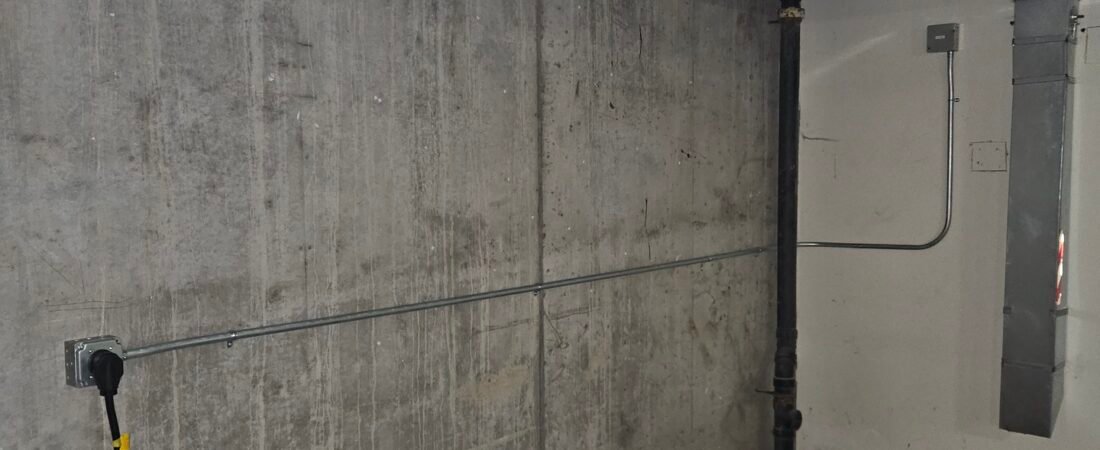
A charger on the garage wall directly behind the panel is a short run. A charger on the far side of the house, or in a detached garage, or anywhere the cable has to cross finished ceilings, is a longer one, and at these amperages the wire is not cheap. The conduit route is often more of the job than the connection at either end.
It is worth deciding where the car will actually park before anyone quotes, because moving that decision later moves the price.
This is permitted and inspected work in Oregon. Your utility may also run incentive programs of its own, and those change on their own schedule, so check directly with them rather than taking anyone’s word for what is currently available.
You probably do not need the biggest charger
Chargers are sold on speed and most people buy more than they will ever use.
Work out how many miles you actually drive on a normal day, then how many hours the car sits at home overnight. For a large majority of drivers, a 32 amp charger covers a day’s driving several times over during a single night, and stepping up to 48 amps buys speed that gets used approximately never.
The larger unit also needs a larger circuit, which needs more capacity and heavier wire, which is exactly the chain that turns a simple install into a panel upgrade. Sizing the charger to your driving rather than to the spec sheet is sometimes the whole difference.
Anthony would rather run that math with you than sell you the biggest thing on the shelf.
What to have ready before you call
You can make the first conversation much faster:
- The make and model of the car, or at least what it can accept
- A photo of the inside of your open panel, showing the breakers and the main
- The number on the main breaker
- Where the car parks, and roughly how far that is from the panel
- Whether a second electric car is likely within a few years
Getting a straight answer
The right first step is a load calculation on your actual house, not a guess from the number on your main breaker.
ATR Electric handles EV charger installation across the Portland metro, including Washington and Clackamas counties, and quotes every job in writing before anything starts.
Request a free estimate or call and ask what your service has room for.