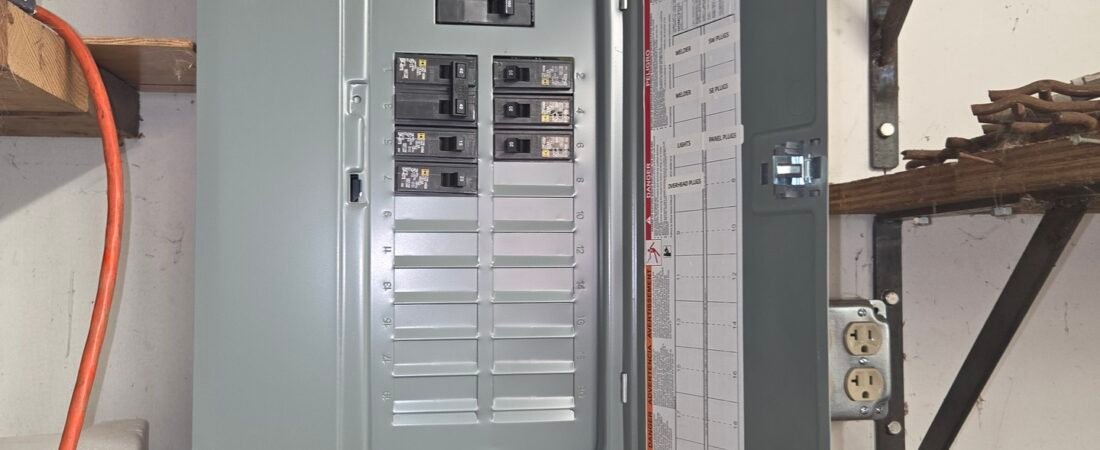
Most people never look at their electrical panel until something stops working. It sits in a garage or a hallway closet, the door stays shut, and as long as the lights come on nobody thinks about it.
That is usually fine. A panel that was sized correctly and installed well can run for decades without asking for anything. But panels do reach the end of their useful life, and they rarely announce it. The signs are quiet, they show up one at a time, and most of them are easy to explain away.
Here is what to look for, sorted by how quickly it matters.
Signs that mean stop and call someone today
These are not maintenance items. If any of them are happening, stop reading and get an electrician out.
- A burning or fishy smell near the panel. Overheated plastic has a distinct sharp smell. Trust your nose on this one.
- Scorch marks, discoloration or melted plastic anywhere on or around the breakers.
- A panel cover that is warm to the touch. The metal front should be room temperature.
- Buzzing, humming or crackling coming from inside the enclosure.
- Visible rust, corrosion or water staining inside the panel or running down the wall behind it.
- Sparks or a visible arc when a breaker is switched.
Any one of these can mean a loose connection, and a loose connection under load generates heat. That is the failure mode that starts fires.
Signs that mean plan an upgrade soon
These are not emergencies. They are the panel telling you it is near the limit of what it can do.
The panel uses fuses instead of breakers. Fuse panels are not automatically unsafe, but they are almost always undersized for how a house gets used now, and replacing a fuse invites the classic mistake of putting in a larger one than the circuit is rated for.
There is no empty space left. Open the door and look at the two columns of breakers. If every slot is full, adding a circuit for anything new means either a subpanel or a new panel.
Two wires are landed under one breaker. This is called a double tap, and outside of a few breakers specifically designed for it, it is not permitted. It usually means somebody needed a circuit and there was no room, which tells you something about the panel’s capacity.
Skinny half height breakers have started appearing. Tandem or twin breakers fit two circuits into one slot. A few are normal. A panel full of them is a panel that ran out of room some time ago.
The same breaker keeps tripping. A breaker doing its job once in a while is a breaker working correctly. One that trips every time the microwave and the toaster run together is telling you that circuit is carrying more than it was designed for.
Lights dim when a large appliance starts. A brief flicker when the heat pump or the dryer kicks on is common. Lights that visibly drop and stay dropped point to a service that is undersized for the load.
There is no single main breaker. Some older panels split the disconnect across several breakers instead of one main. They can be perfectly functional, but there is no single switch that kills power to the house, which matters in an emergency and to anyone working on the system.
Some panels have a documented history
A few brands have well recorded problems with breakers that fail to trip under fault conditions. Federal Pacific Stab-Lok and Zinsco are the two that come up most often in this metro, and they turn up regularly in homes that have never had an electrical problem in their life.
That is exactly what makes them worth knowing about. A breaker that fails to trip does not misbehave first. The panel looks completely normal right up until the moment it is asked to do the one thing it exists to do.
If either name is on your panel, it is worth having looked at even if nothing is wrong. Some home insurers and some buyers ask about them directly, so it can also come up at a point in the process where you have no time to deal with it.
Sometimes the trigger is a project, not a problem
Plenty of panel upgrades have nothing to do with anything being wrong. The panel was correctly sized for the house as it was, and then the house changed.
Common reasons a working panel stops being enough:
- Adding a charger for an electric vehicle, which is one of the largest continuous loads a home can carry
- A hot tub or a pool
- Converting to a heat pump or adding mini splits
- A kitchen remodel, which usually means several new dedicated circuits
- Finishing a basement, adding a shop, or building an ADU
None of these are a sign of a bad panel. They are a sign of a panel being asked to do a job it was never sized for. An electrician runs a load calculation to answer that question properly rather than guessing from the number on the main breaker.
What actually happens during an upgrade
Knowing the shape of the job makes it easier to judge a quote.
A service change is permitted work in Oregon, and it is inspected. Power to the house has to be disconnected at the meter, which means coordinating with your utility, and that scheduling is often what sets the timeline rather than the electrical work itself. Expect to be without power for a chunk of a day.
The panel comes out, the new one goes in, every circuit gets landed and labeled, and the work is inspected before the utility reconnects. A finished job leaves you with a printed directory in the door so the next person to open it knows what everything does.
When the honest answer is that you do not need one
Not every one of these signs means replacement.
A single circuit that trips regularly is often a circuit problem, not a panel problem, and troubleshooting the circuit is a far smaller job. A full panel can sometimes be solved with a subpanel rather than a service change. An older panel in good condition, with room to spare and no history of trouble, may have years left in it.
Anthony would rather tell you that than sell you a panel you do not need. Anyone quoting a service change without opening the panel and running the numbers is guessing, and you are entitled to ask what the load calculation said.
Getting a straight answer
If something on this list sounds like your panel, the next step is having someone look at it and tell you plainly which category it falls into.
ATR Electric handles panel upgrades and service changes across the Portland metro, including Washington and Clackamas counties. Every job is quoted in writing before anything starts.
Request a free estimate or call and ask.